Gita and Dana's friendship
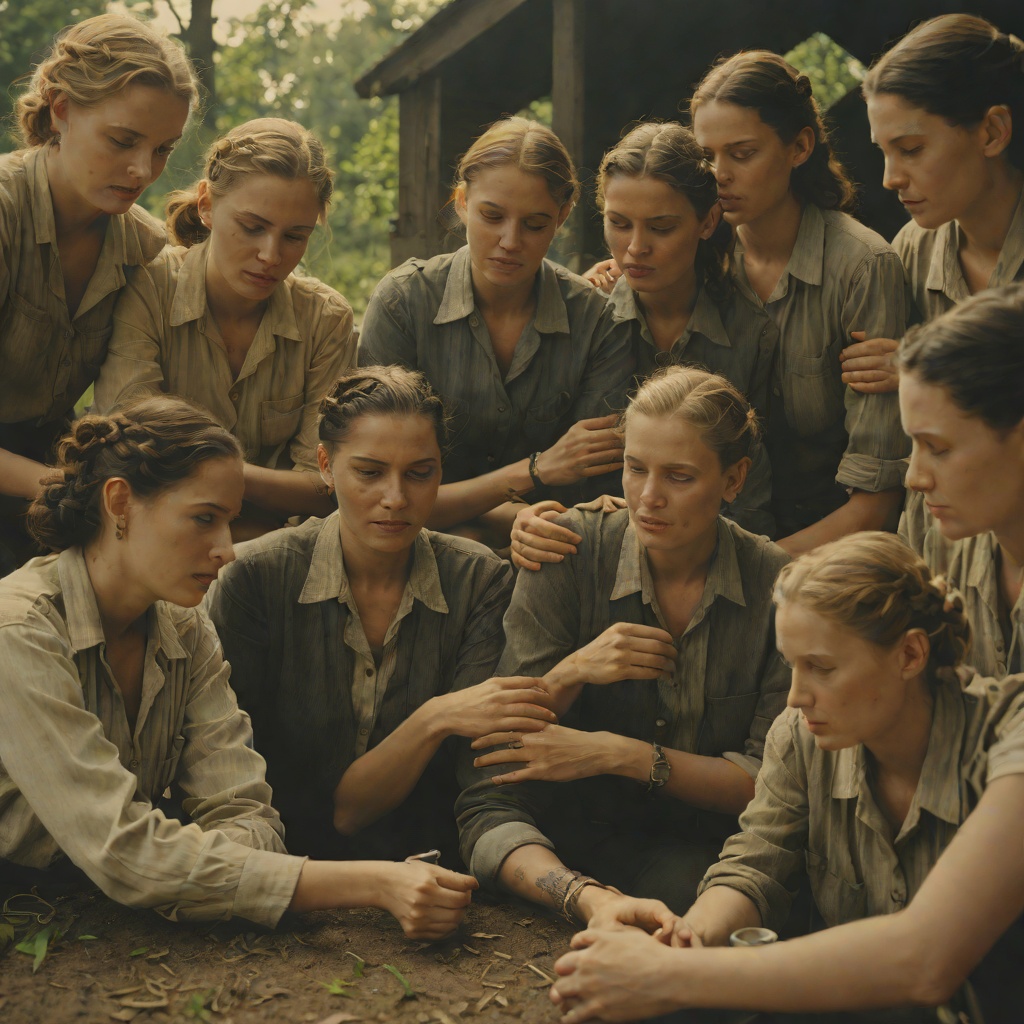
The Tattooist of AuschwitzGita and Dana's friendship is the emotional bedrock of the women's camp at Auschwitz-Birkenau, a bond of mutual devotion that functions as a lifeline in a place engineered to strip prisoners of every human attachment. From the cramped darkness of Block 29 to the frozen fields of the death march, Dana repeatedly places Gita's survival above her own, while Gita's love for Lale becomes a joy that Dana guards and celebrates as if it were her own. Their relationship is not merely companionship but an active, desperate project of keeping each other alive, and its final rupture on the evacuation road is one of the most quietly devastating losses in the narrative.
The Bond in Block 29
The friendship is first seen in its most intimate setting: Block 29 in the women's camp, where Gita curls up with Dana and Ivana, straining to read Lale's letter by a beam of floodlight seeping through a crack in the timber wall. When Dana asks how long ago the letter arrived, Gita giggles that it came about two hours ago, and Dana hugs her friend tightly. The scene establishes the texture of their closeness—a shared, almost girlish warmth preserved inside the brutal machinery of the camp. Dana is present for Gita's emotional life in a way no one else can be, receiving her confidences and responding with physical affection that the camp otherwise denies. When Gita later jokes about having kissed her mother and father goodbye before catching the bus to work, the bitter irony of her words lands within the safety of this friendship, where even gallows humor can be shared.
The Typhus Crisis
When typhus strikes Gita, Dana becomes her fiercest advocate and nurse. Lale, pacing near the women's camp in the cold, spots Dana appearing and hurrying over—she is the one who carries the news that Gita is sick. Dana pleads with Lale for help, explaining that if they go to the hospital and ask for penicillin, the authorities will simply take Gita away. "I can't lose her. I've lost all my family," she says, revealing that Dana has already been stripped of every relative and that Gita has become her sole remaining attachment. Lale's instructions are stark: Dana must carry or drag Gita to the Canada warehouse each morning, hide her among the clothes during the day, force water into her, and bring her back for roll call, repeating this for days until medicine can be obtained. Dana executes this plan with grim determination, and when Lale watches from a distance, he sees Dana and Ivana emerging with Gita hanging weakly from their shoulders, two other girls helping to block the scene from view. Lale drops to his knees at the thought that this could be the last time he sees her, but Dana's labor keeps Gita alive. In the evening, Dana and Ivana sit beside a now fully unconscious Gita, talking to her though she gives no sign of hearing, while Dana places drops of liquid into Gita's mouth from a small vial as Ivana holds it open. The division of labor between the two friends—Dana administering the medicine, Ivana steadying Gita's jaw—shows a practiced, almost clinical tenderness born of desperation.
Shared Grief and Shared Joy
When Gita receives devastating news from Mrs. Goldstein, she crumbles to the floor, and Dana and Ivana rush to her, sitting on the ground and embracing her. Both friends cry while holding the dry-eyed Gita, babbling words of condolence as she feels a terrible emptiness inside. Gita's halting question—"Do you think maybe it's OK for me to cry? Just a little bit?"—reveals how deeply the camp has suppressed even the capacity for grief, and Dana's presence is what makes the question possible at all. Yet the friendship also carries joy. When Lale declares his love for Gita, Dana articulates the selfless logic of their bond: "It is enough that one of us has a little happiness. We share in it, and you let us—that's enough for us." Dana does not envy Gita's love; she lives through it, finding in her friend's happiness a reason to endure. This is the friendship's deepest function: in a world where every individual is reduced to a number, Dana and Gita create a shared emotional economy in which one person's joy is a collective resource.
The Return of Lale and the Threat of Baretski
The friendship is tested by external threats. When Stefan Baretski enters the women's camp as the prisoners line up for dinner, Cilka sees him approach the kapo and point at Gita. The kapo beckons Gita, and as she slowly walks over to Baretski, Dana draws in close, unable to hear what is said but watching as Gita covers her face with her hands and then runs back into her friends' arms. Dana is the witness to Gita's terror, the one who holds the space for her to return to. When Lale finally reappears after his imprisonment, waiting outside the administration building as the girls leave work, Dana and Gita do not see him until he blocks their path. Both girls throw their arms around him and hug him tightly; Dana cries, while no tears come from Gita. Dana kisses Lale on the cheek and withdraws, saying, "I'll leave you two. It's so good to see you, Lale. I thought Gita would die of a broken heart if you didn't come back soon." Her tears and her words reveal how deeply she has invested in the couple's survival—Gita's heartbreak would be Dana's own.
The Death March and the Final Separation
The friendship meets its tragic end on the evacuation from Birkenau. As the prisoners march through the night, their numbers dwindling, Dana drops to her knees, unable to go on. Gita stops with her, and for a while they are unseen, screened by other women. Dana keeps telling Gita to go on, to leave her, but Gita protests, saying she would rather die here with her friend in a field somewhere in Poland. Four young girls offer to help carry Dana, but she will not hear of it, telling them to take Gita and go. As an SS officer advances, the four girls pull Gita to her feet and drag her with them. Gita looks back at the officer, who stops beside Dana but moves on without drawing his pistol—no shot rings out, because he clearly thinks she is already dead. The girls continue to drag Gita as she attempts to break free and get back to Dana. The scene is a brutal inversion of everything their friendship has been: Dana, who carried Gita through typhus, now refuses to be carried herself, sacrificing herself so that Gita might live. Gita's desperate struggle to return to her friend is the measure of how much Dana has meant to her, and the officer's indifference to Dana's body is the camp's final, cruel verdict on a life spent in devotion to another.
Narrative Significance
Before the separation, Lale takes Dana by both hands and tells her how grateful he will always be for her being Gita's friend, acknowledging that she has kept Gita going many times when Gita has wanted to give up. They embrace, and Lale kisses her on the forehead before handing her over to Gita. This farewell, spoken while Lale still has the chance, gives Dana her due recognition within the story. Her friendship with Gita is the narrative's proof that love could survive the camp's dehumanization—not only the romantic love between Lale and Gita, but the steadfast, self-sacrificing love between two women who had lost everything except each other. Dana's death on the march, unmarked by any shot, is the story's quiet acknowledgment that some bonds are broken not by violence but by exhaustion, and that the will to live is sometimes passed from one person to another like a gift that cannot be returned.